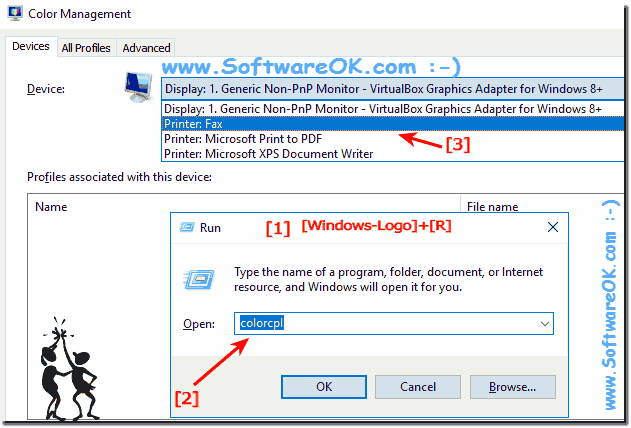
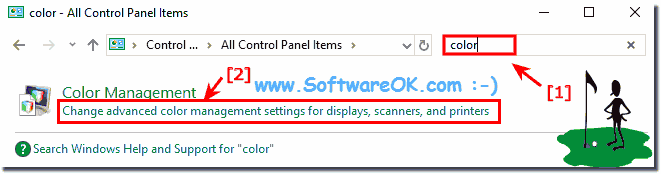
1. The command for Windows 10 and 11 Color Management is: colorcpl to start it from the nice Windows-10 Run Dialog keyboard-shortcut Windows+R.
2. In the Windows 11 and 10 Color Management please select the Device to make changes in the color profile.
(... see Image-1)
(Image-1) Window-10 Color Management for Devices!
In a color management system, color profiles are used to create color transforms, which Windows 10 programs use to convert color from one device’s color space to another. A color space is a three-dimensional model in which the hue, lightness, and chroma of colors are graphed to represent the rendering capabilities of a device. When a new device is added to your computer, a color profile for that device might be installed automatically on Windows 10.
A color profile in Windows 10 is a file that describes the color characteristics of a specific device while it's in a particular state. A profile can also contain additional information defining viewing conditions or gamut-mapping methods. Working with your computer's color management system in Windows 10, color profiles help ensure that color content is acceptably rendered, regardless of the device or viewing condition.
3.) Create shortcut on The Desktop for Color-Management!
The fastest and simplest solution to create a Desktop shortcut for Color-Management in Windows 10 is:
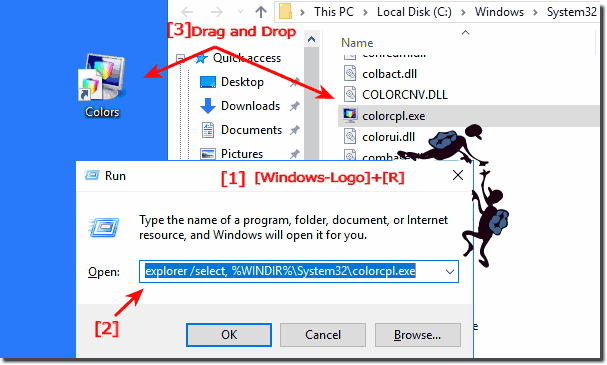
Please start the MS-Explorer from Window 10 Run Command (Windows+R) and enter the command: explorer /select, %WINDIR%\System32\colorcpl.exe
This command will start the File-Explorer and select the colorcpl.exe in C:\Windows\System32\ folder.
And now use please the Right Mouse for a Drag and Drop action. Rename the Desktop Shortcut for example to COLOR on your Windows 10 Desktop. (... see Image-3 Point 1 and 3 ) that is a fast and simple solution :-)#i3
There are two main types of color profiles that Windows 10 continues to support: Windows 10 Color System (WCS) and International Color Consortium (ICC) color profiles. This provides you with the greatest variety of choices for customizing color management options and color workflows. WCS is an advanced color management system found in recent versions of Windows 10. While supporting ICC profile–based color management, WCS provides advanced capabilities not found in existing ICC color management systems.
The solution to activate the Window 10/11 Start Sound and also for User Logoff, or Logon / Login on Windows 10 and 11 This solution is also for other Microsoft
The Windows-10 Device Manager Desktop Shortcut allows fast access to Device Manager from the Desktop, for example, to see if all the drivers are installed
The Windows 10 performance index is calculated by the operating system but no longer in System The solution is simple to find Experience Index eg. PC rating
If you upgrade from Windows 7 or Windows 8.1 / 8 to new Windows 10 , here are some things to keep in mind Yor can upgrade from Windows 7/8.1 x64 to Windows
This website does not store personal data. However, third-party providers are used to display ads, which are managed by Google and comply with the IAB Transparency and Consent Framework (IAB-TCF). The CMP ID is 300 and can be individually customized at the bottom of the page. more Infos & Privacy Policy ....