The popular Windows Media Player is easy to find on Windows 10, 8.1, .... and MS Server 2022, ....!
I have integrated the Windows Media Player in the Quad Explorer, which can serve as a preview for videos and media files, since the Windows 10 does not have the Windows Media Center in the standard installation, the Windows Media Player is on Windows 10 a very good player that can play mkv, avi, mp4, divix, flack, mp3, ... well!
TIP: ►► The freeware MediaPlayerOK for Windows
1. Find and start Windows Media Player on Windows 10/11!
2. Activate WMP (if not installed)
3. Alternative modern media players from Microsoft
4. Set WMP as the default program
5. Troubleshooting: WMP won't open/is missing despite searching
6. Additional launch methods (keyboard shortcuts/PowerToys)
7. Conclusion/Recommendation
1.) Find and start Windows Media Player on Windows 10 / 11!
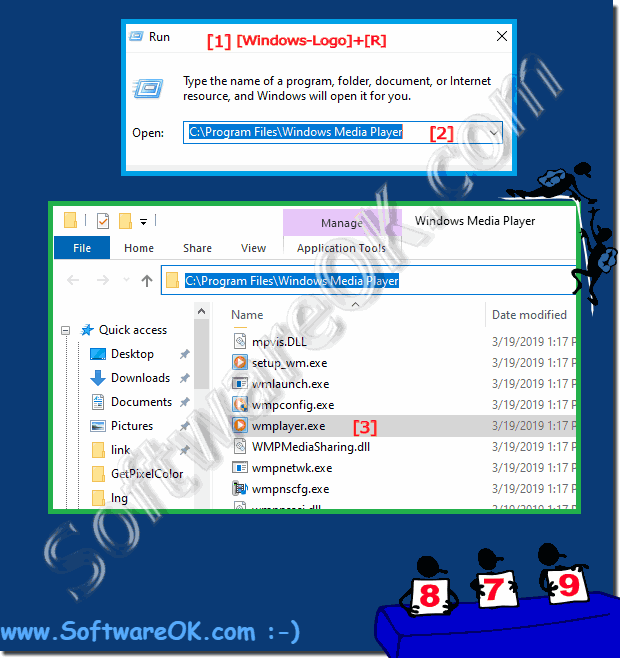
1. Simply open the directory "C:\Program Files\Windows Media Player"
2. and start the x64 variant of Windows Media Player
or:
"C:\Program Files (x86)\Windows Media Player" the 32 bit version!
PS:
Alternatively, you can right-click the Start button to bring up the hidden quick access menu and select Run, or use the key combination Windows Key + R. Then type wmplayer.exe and press Enter.
| (Image-2) FIND THE Media Player on Windows 10! |
![]() |
Info:
Windows Media Player has not changed at all since the last update to version 12 in Windows 7. If you've recently upgraded from Windows 7 to 10 and aren't ready to use the new apps yet, you'll enjoy the familiar interface. It is obvious that Microsoft wants to give up some of the desktop programs and develop them as new universal apps.
2.) Activation of WMP (if not already installed)
The article mentions in the FAQs at the end that Windows Media Player is not installed by default in some Windows editions (especially the "N" versions for Europe). This would be an important sub-point:
* Installing/activating Windows Media Player: Step-by-step instructions via "Apps & Features" → "Optional Features" → "Add a feature" → "Windows Media Player". This is particularly relevant for users who are looking for it but can't find it.
3.) Alternative modern media players from Microsoft
The article mentions that Microsoft is focusing on "universal apps." You could clearly name and differentiate the modern alternatives:
* The "modern" Media Player app (Windows 11): Pre-installed by default, streamlined interface, better for touch and current codecs (like HEVC, if installed).
* "Movies & TV" (formerly "Groove Music"): Also a UWP player, often still present.
* Differentiation: When do you use the classic WMP (e.g., for CD ripping, library management, visualizations) and when do you use the modern apps (for quickly playing individual files)?
4.) Set WMP as the default program
The FAQ asks: "How do I set Windows Media Player as the default?" . This is a practical, standalone point:
* Set WMP as the default for media files: Instructions via "Settings" → "Apps" → "Default apps" → "Choose by file type" (e.g., for .mp4, .mp3) or "Choose by protocol" (e.g., http://).
5.) Troubleshooting: Windows Media Player cannot be opened / is missing despite searching.
Based on the many FAQs in the article, you could add a short troubleshooting section:
* Common problems and solutions:
* WMP was disabled by a Windows update.
* The executable file (`wmplayer.exe`) is present, but launching it via the menu doesn't work (broken shortcut).
* WMP cannot play certain files (e.g., MKV, FLAC) – Solution: Codec packs (with warning).
6.) Additional startup methods (keyboard shortcuts / PowerToys)
The article mentions `Windows + R` and `wmplayer.exe`. This can be expanded upon:
* Create your own keyboard shortcut: Create a desktop shortcut with `wmplayer.exe` and assign a custom keyboard shortcut (e.g., `Ctrl + Alt + W`).
* With PowerToys Run: If the user has PowerToys installed, simply type `Alt + Spacebar` → `wmp`.
7.) Conclusion / Recommendation
* For whom is the classic Windows Media Player still useful in 2026? (e.g., for users who want a simple, ad-free library without cloud requirements, or for playing audio CDs).
* Outlook: The article mentions that Microsoft actually wants to discontinue Windows Media Player. This suggests that it will still exist, but will no longer receive new features.